



We’re pleased to announce the first CRAN release of mori.
Until now, parallel R has meant serializing your data to every worker and duplicating it in each worker’s RAM. Eight workers × 1 GB is 8 GB, plus the serialization, transfer, and deserialization cost to get it there. R processes don’t share memory — each has its own heap, so data crosses between them through a serialization pipe.
mori changes that. It places an R object once into OS-level shared memory and lets every process on the machine read the same physical pages directly — with no data copying between processes.
install.packages("mori")mori is built on R’s ALTREP (Alternative Representation) framework, which lets a package expose a custom vector backend that reads its data from somewhere other than ordinary R memory — a memory map, a database, a compressed store, or in this case, OS shared memory.
How it looks#
The entry point is share(). You pass it an R object, you get back a shared version that you can use in the same way as the original:
library(mori)

set.seed(42)
x <- share(rnorm(1e6))
mean(x)
[1] 0.0005737398
share() works on atomic vector types, lists, and data frames — it writes them directly into shared memory with attributes preserved. In practice that also covers tibbles, data.tables, factors, dates, and matrices, since they’re built on those types. Environments, functions, S4 objects, and external pointers are returned unchanged, since their state can’t be meaningfully exposed as raw bytes in shared memory.
The returned object is an ALTREP view into shared memory — it costs no additional RAM beyond the original region. It also serializes compactly: instead of sending the full 8 MB payload, mori’s ALTREP hooks serialize shared objects as their shared-memory name, just over 100 bytes on the wire.
x |> serialize(NULL) |> length()[1] 125
That compact serialization is what makes the rest of the picture work.
Parallel workers, one copy#
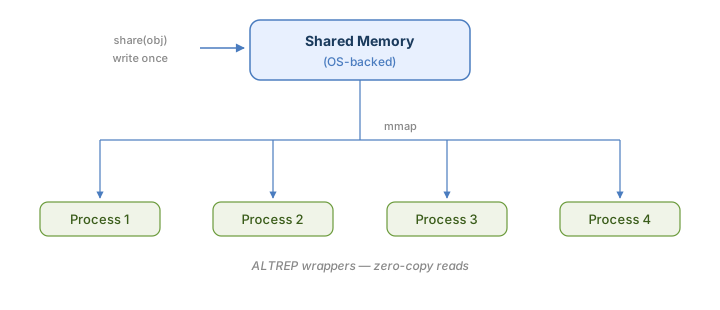
mori pairs naturally with mirai. When you send a shared object to a local daemon, only the shared-memory name crosses the wire; the daemon maps the same physical pages and sees the full data with no deserialization cost. The same is true for any other parallel backend that uses R serialization.
Here’s the motivating case — a bootstrap across eight workers on a 200 MB data frame:
library(mirai)
library(purrr)

daemons(8)

df <- as.data.frame(matrix(rnorm(25e6), ncol = 5))
shared_df <- share(df)

boot <- \(i) colMeans(data[sample(nrow(data), replace = TRUE), ])

# Without mori — each daemon deserializes its own copy
system.time(
  map(1:8, in_parallel(\(i) boot(i), boot = boot, data = df))
)
user system elapsed
0.445 3.338 10.454
# With mori — each daemon maps the same shared memory
system.time(
  map(1:8, in_parallel(\(i) boot(i), boot = boot, data = shared_df))
)
user system elapsed
0.001 0.000 4.959
daemons(0)The payload each daemon receives is ~300 bytes instead of 200 MB — roughly 700,000× smaller. There’s a ~2× wall-clock saving on this run, and eight workers now share a single 200 MB copy in memory instead of materializing one each. The function call is the same; the savings come from not copying data that’s already in RAM.
share() itself is paid once upfront — roughly the cost of one serialization to write into shared memory. Daemons don’t pay a deserialize cost on the other end, since they read the same physical memory directly — so even a single send is a net win, and the savings compound with every additional daemon.
The wall-clock gap depends on how much of the run is data transfer versus compute. On cheap per-task work — bootstrap, cross-validation, parameter sweeps — serialization dominates and the wall-clock win is largest; the ratio shrinks as each task starts to involve more substantial compute, although we always get the memory saving.
Lists and data frames travel element-wise too: sending a single column of a shared data frame transmits only that element’s reference, not the whole data frame.
daemons(3)

x <- share(list(a = rnorm(1e6), b = rnorm(1e6), c = rnorm(1e6)))

mirai_map(x, \(v) lobstr::obj_size(v) |> format())[.flat]
a b c
"840 B" "840 B" "840 B"
daemons(0)What this unlocks#
Anywhere parallel R workers process the same large dataset, share() removes the per-worker copy:
- A Shiny dashboard where every worker process reads from one shared reference dataset instead of loading its own.
- A tidymodels
tune_grid()sweep — or a targets pipeline branching over model variants — where every fit reads the same training data without copying it. - Bootstrap, Monte Carlo, or permutation work dispatched across mirai or crew, where thousands of iterations all read from one shared dataset.
The pattern is the same in each case: call share() on your dataset once, then pass the result wherever you’d normally pass the data. Parallel dispatches that hit the serialization path transmit only the reference, not the data.
Access and lifetime#
A shared data frame lives in a single shared region, but ALTREP columns are only materialized when touched. A task that reads three columns out of one hundred pays for three — character vectors are lazier still, with per-element access. Workers only pay for the data they actually touch.
Shared memory is tied to R’s garbage collector. As long as the shared object (or anything extracted from it) is live in R, the data stays available; when the last reference is dropped, it’s freed automatically with no manual cleanup. The process that called share() needs to hold its reference until a consumer has mapped a view — from that point on, the view itself keeps the shared memory alive.
Mutations go through R’s normal copy-on-write: editing a value inside a shared vector produces a private copy of that one vector, leaving the rest of the shared region untouched.
x <- share(rnorm(1e6))
lobstr::obj_size(x)
960 B
x[1] <- 0  # local mutation materializes a private copy
lobstr::obj_size(x)
8.00 MB
Sharing by name#
If you want to access a shared region from another process without going through serialization at all, you can pass its name directly:
x <- share(1:1e6)

nm <- shared_name(x)
nm
[1] "/mori_113fe_4"
# Works from another process; same session here to demonstrate
y <- map_shared(nm)
identical(x[], y[])
[1] TRUE
Handy when the consumer needs to attach by name rather than receive the shared object through R’s serialization path.
How mori fits#
R has had partial answers to cross-process data sharing before. bigmemory offers shared big.matrix objects — effective, but limited to numeric matrices. SharedObject on Bioconductor targets a similar goal with its own memory-sharing machinery, oriented around BiocParallel workflows. Arrow’s memory-mapped Parquet gives zero-copy columnar reads across processes, though the data lives on disk. On Unix, parallel::mclapply gets shared memory via fork copy-on-write (until a worker writes to a page), with the usual fork caveats (unsafe in GUI sessions, with open DB connections, or alongside multithreaded libraries), and with no equivalent on Windows.
mori is usable across any backend that plugs into R’s standard serialization — mirai, future, parallel, foreach, callr — with no special cooperation required. Atomic vectors, lists, and character vectors are all supported, with lazy per-element access preserved in every process. Lifetimes are managed by R’s garbage collector: shared regions are freed automatically when the last reference drops. And mori itself is pure C — POSIX shared memory on Linux and macOS, Win32 file mapping on Windows, nothing beyond the package to install.
Try it#
mori is available from CRAN. The package website has a walkthrough of the mirai integration and full reference documentation. mori is designed to slot quietly into existing parallel-R workflows — anywhere a worker currently receives a big dataset, share() it first and you’re done. It complements mirai: mirai handles async evaluation and daemon coordination, mori handles shared access to the data those daemons work on.
The package is in the experimental lifecycle stage while the API settles, so feedback and issue reports on GitHub are very welcome.