


The AI newsletter is published as an RSS feed. Follow it in your favorite reader:
Want the newsletter as an email? Paste the feed URL, https://opensource.posit.co/tags/ai-newsletter/index.xml, into a free RSS-to-email service such as Blogtrottr, Feedrabbit, or Follow.it, and each new issue will arrive in your inbox.
Last month, we gave a posit::conf(2026) keynote on building correct, transparent, and reproducible data agents. The talk brings together many themes from this newsletter, so this week we’re sharing an annotated walkthrough. You can also see the full slide deck here.
Correctness vs. convenience#
(Simon)
This morning, your VP pulled up a coding agent and asked a reasonable question:
How is traffic trending for our site?
The agent looked around the workspace, found a table that seemed relevant, wrote a SQL query against it, and returned a polished chart. Daily visits, it said, were down 64% over the last 90 days.
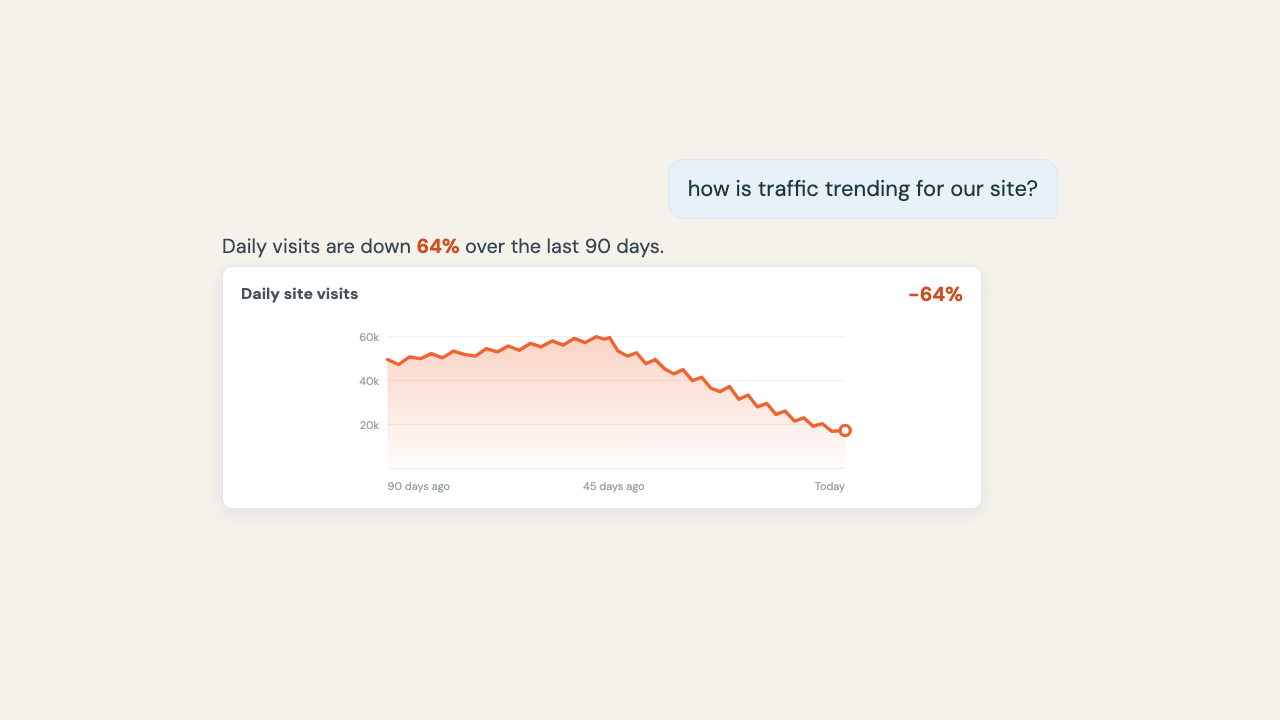
The variation looks a little tight, and the bend is a little sharp. Is there any possible reason we might see that bend other than a genuine change in site traffic?
It turns out that a version of Chrome released 45 days earlier fired the page-view event differently, so it was not aggregated correctly in the database. As people updated Chrome, it appeared that site visits were trending down. This was not even the table the data science team used to track site traffic.
But you are not there! Your VP sees this chart and takes it to the rest of the leadership team. They decide to restructure the organization and spend millions of dollars to reverse the trend.
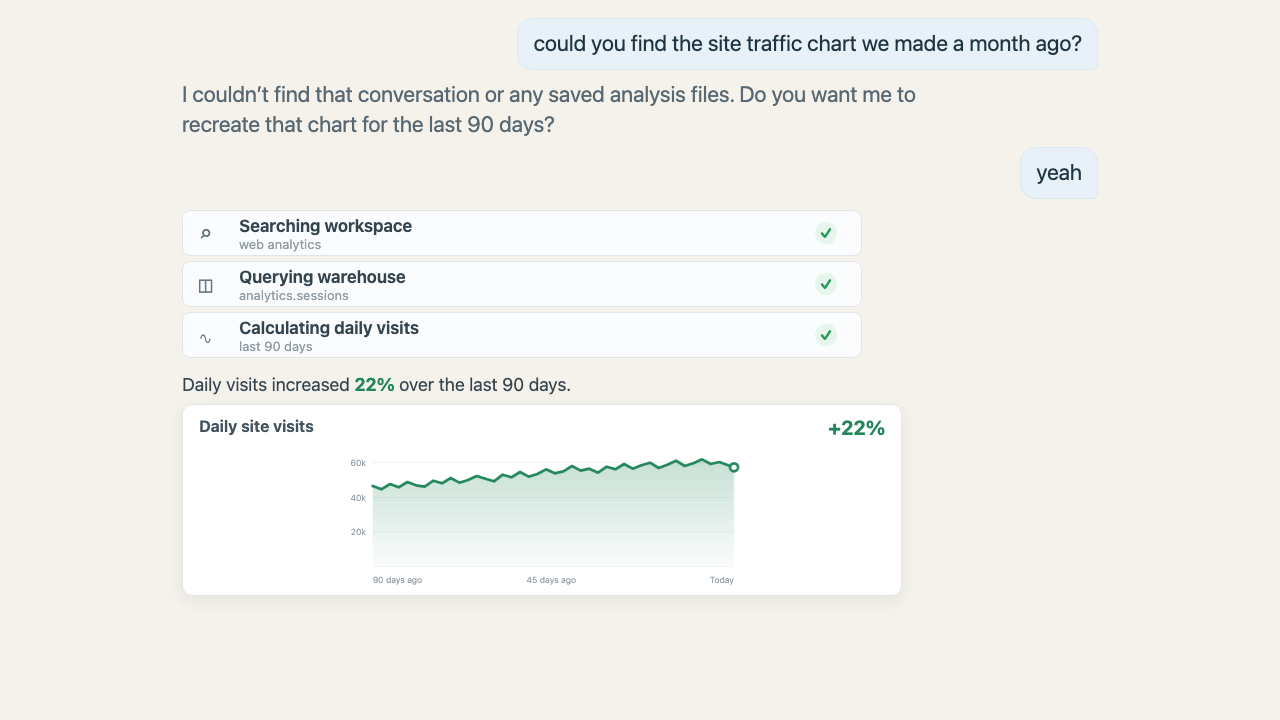
A month later, somebody asks, “Could you recreate that chart? Let’s see how things are trending now.” The agent cannot find it. Many coding agents delete conversation histories after 30 days, and they often do data analysis in temporary files so they do not clutter the project directory. The source code for the analysis is long gone.
The coding agent offers to recreate the chart. It looks around the workspace, finds a table, and runs some SQL. The number was going up the whole time.
This is a fictional story, but we’e seen situations like this internally at Posit and at many of the organizations we work with. It is becoming normal to vibe-analyze data: ask an agent a question, receive a plausible answer, and move on without understanding how it was produced.
The tension between correctness and convenience is not new#
Posit CTO Joe Cheng summarized the current moment this way:
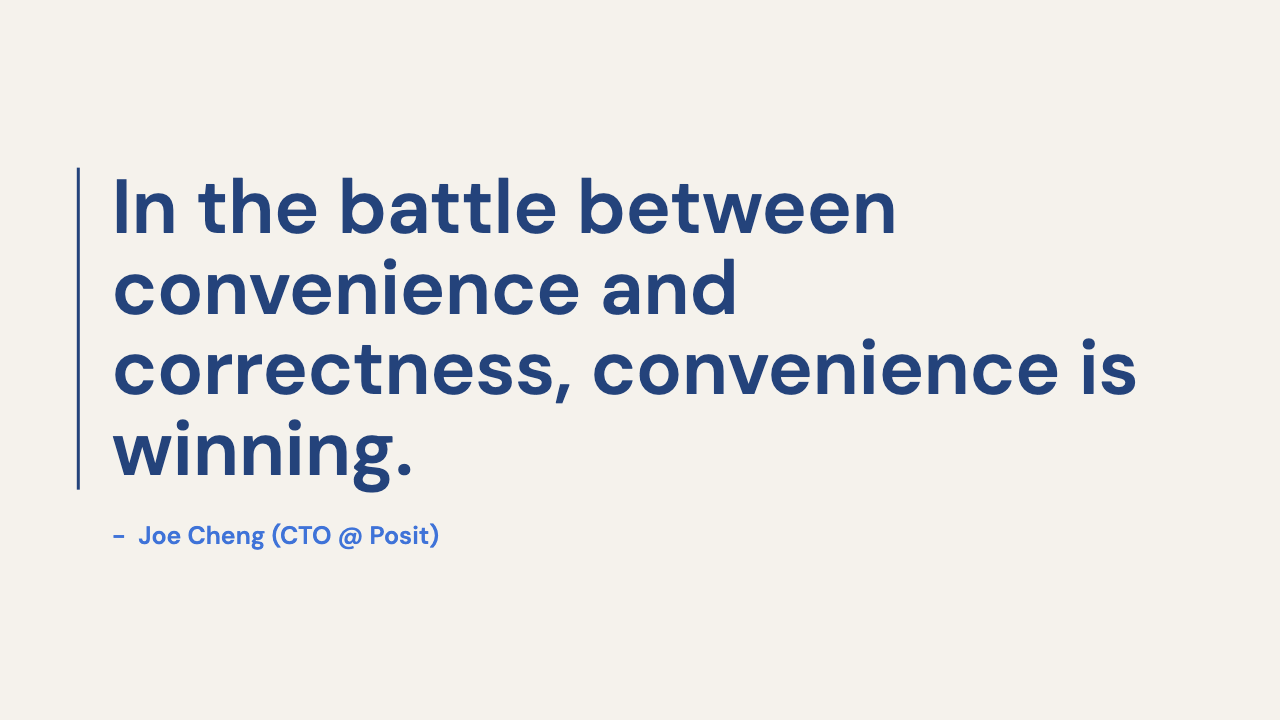
AI has broadened the group of people who can convincingly do data analysis, but many may have no idea what data scientists go through to produce a trustworthy analysis.
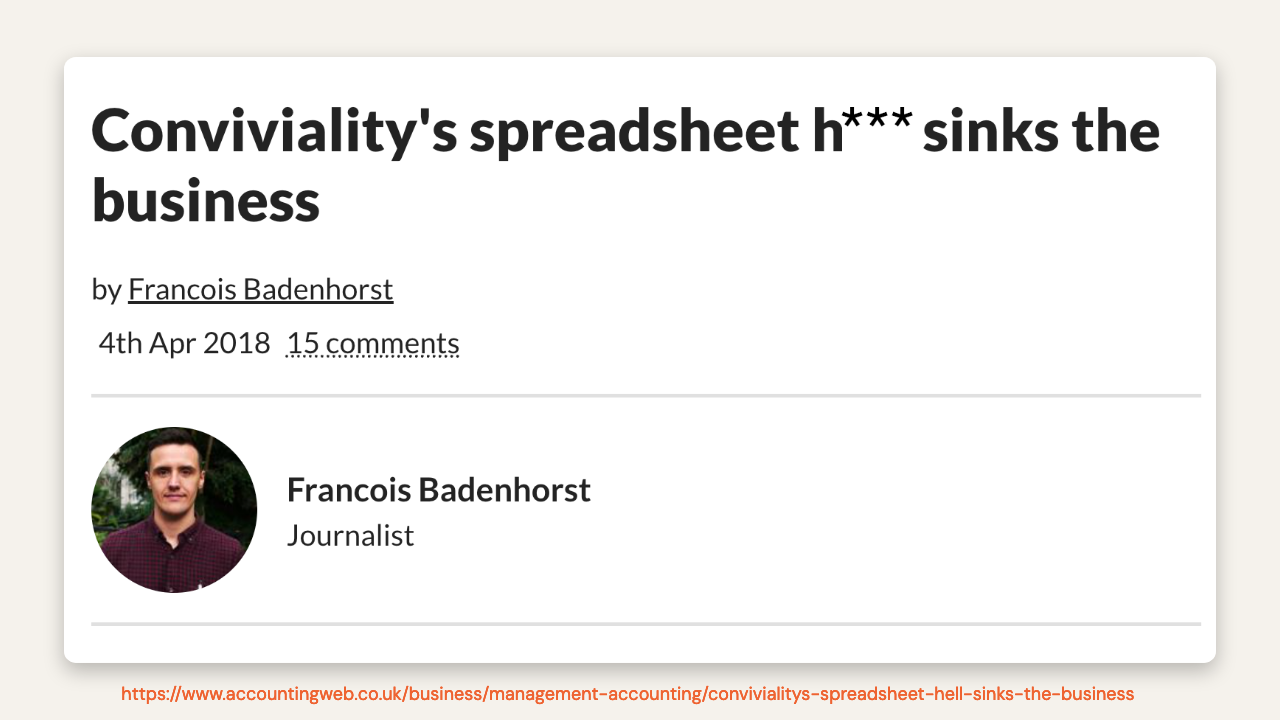
Joe said this a month before the keynote, but he could have said it seven years ago. In 2019, the beverage company Conviviality disclosed that a spreadsheet arithmetic error had contributed £5.2 million to a £14 million forecasting mistake. When that “innocent spreadsheeting mistake” came to light, the business sank.
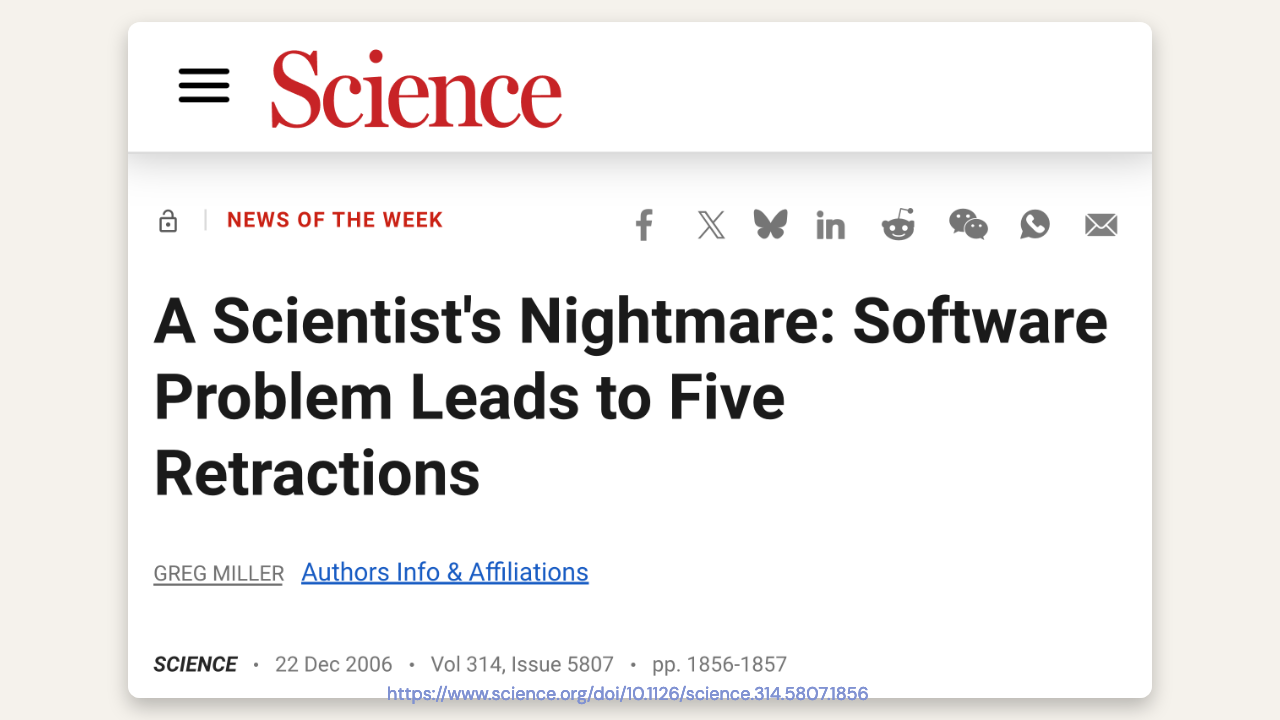
Or Joe could have said it 20 years ago, when a sign error in closed-source protein-modeling software sent a research field down the wrong path. A lab published landmark study after landmark study while other labs struggled to reproduce its findings. Only after another lab found a protein structure that was nearly a mirror image of one that the first lab had published did the first lab audit its source code. They found a negative sign where it did not belong and retracted five papers.
There were threats to correctness in data analysis long before AI. Posit’s stance has never been that people must sacrifice convenience for correctness. While preparing the talk, I found this quote in a blog post old enough to refer to itself as a “weblog”:
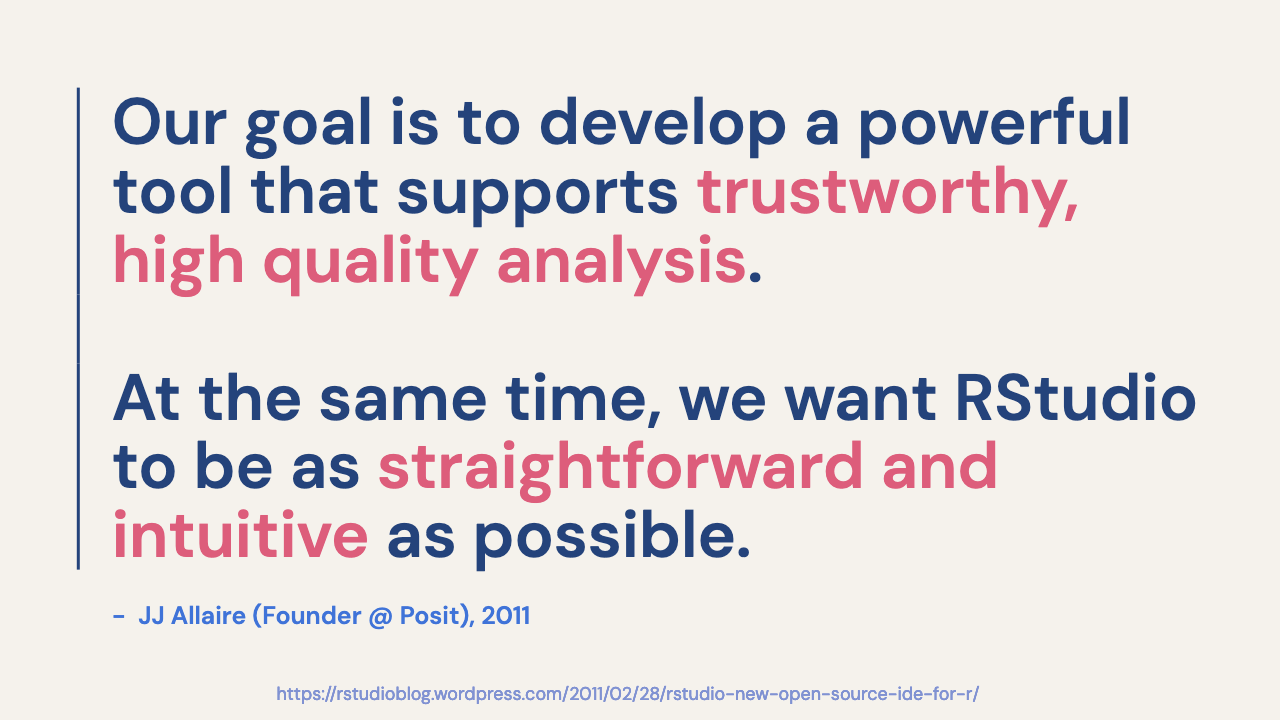
JJ was saying that a tool could be both correct and convenient. (By convenient, we do not mean 7-Eleven. We mean straightforward and intuitive.😜)
Can we take the same stance toward AI? Is it possible to make data analysis agents that are both correct and convenient for end users?
Why build AI tools at all?#
(Sara)
This pull between correctness and convenience has been on our minds throughout the new, exciting age of LLMs. In 2025 and early 2026, AI started to feel really, really convenient for data analysis. That made us worry about correctness.
In August 2025, when we released Databot, our state-of-the-art exploratory data analysis agent, we did so under what was essentially a warning label. The release post was one of the first things I worked on after joining the AI team, and it gave me the chance to do something I think I am particularly good at: be pessimistic.
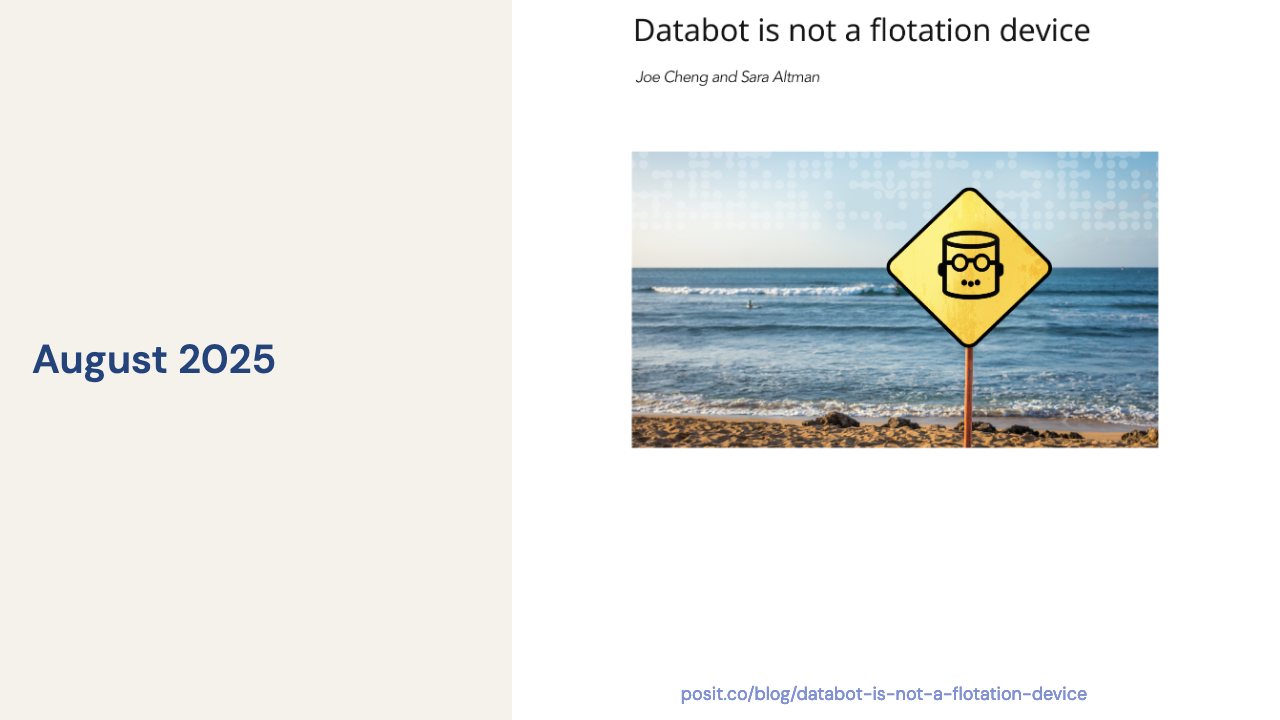
We were all really excited about Databot. It felt like flying through your data, gathering insights faster than you thought would ever be possible. It was precisely that convenience that worried us. People might trust it because they were having so much fun, even when it was wrong. So we wrote an entire article detailing basically every way we thought Databot might fail.
If you were at posit::conf(2025), you might remember Joe Cheng describing it as both the most exciting and the most dangerous software he had worked on in his 30-year career.
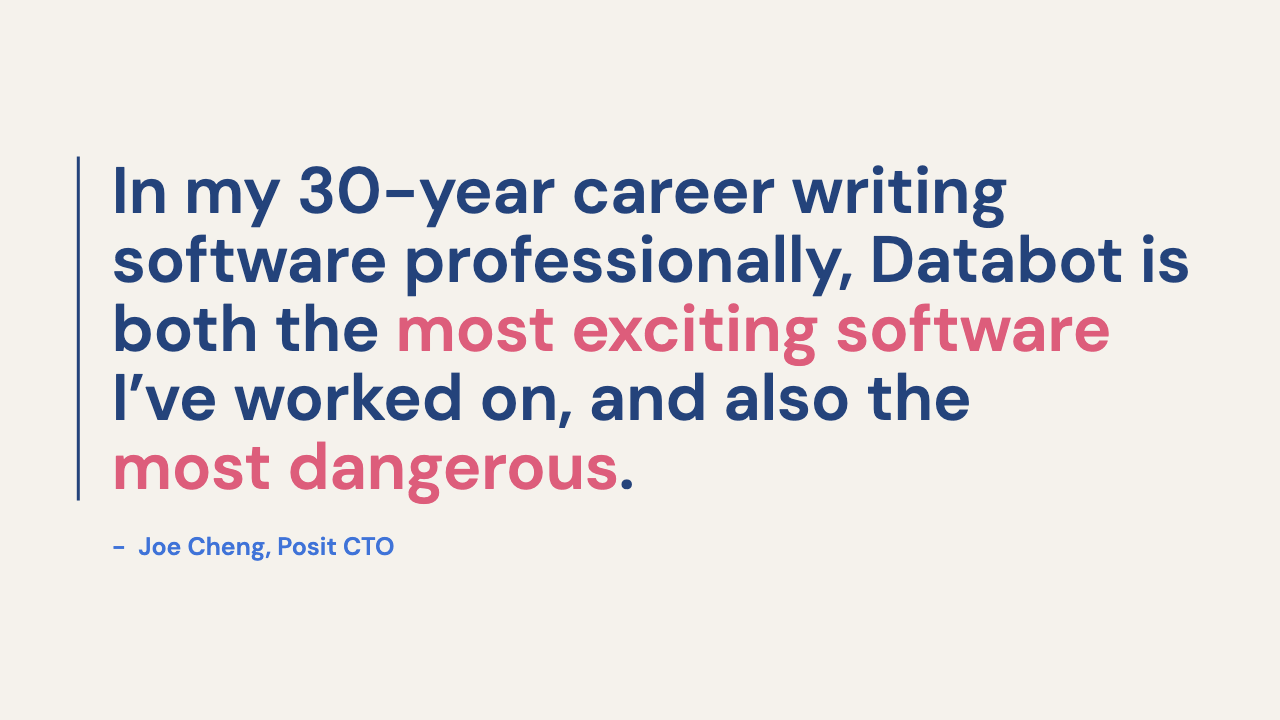
That raises a fair question, one we contemplate ourselves on a weekly basis: If AI causes all this chaos and makes all these mistakes, why are we doing this? Why involve ourselves at all?
There are many answers. We’ll focus on one.
Curiosity and exploration#
Before joining the AI team, I taught data science. One thing that always struck me was what brought people with very different backgrounds into the field. The thing that united many of them was a sense of curiosity. Maybe they were curious about a scientific field, computers, statistics, or how R and Python themselves work. Data rewards that curiosity: There are datasets on almost everything.
But even as an undergraduate who knew some statistics and a little R, I often felt like I was looking at an ocean from above. The dataset was right in front of me, and I knew there was so much going on, but I just couldn’t see it.

As a graduate student, I learned the tidyverse and more about data science. As I got better at using those tools, I finally felt like I had what I needed to ask and answer questions about my data.

The right tools let us see below the surface. They enable that curiosity.
That same curiosity motivates our work now. We are curious about how these models work, how we can build things around them to make them work better, and, maybe most importantly, how we can turn them into tools that open new worlds of analysis. For us, AI is a continuation of work we have always done: finding new ways to explore data.
The models got better#
I also wanted to spend some time on what has changed since August 2025, when we released that warning-label image. One major thing happened: The models got better.
About a year before the keynote, we ran an experiment to understand how well models interpret plots. We showed them plots based on a transformed diamonds dataset and asked them to describe what they saw.
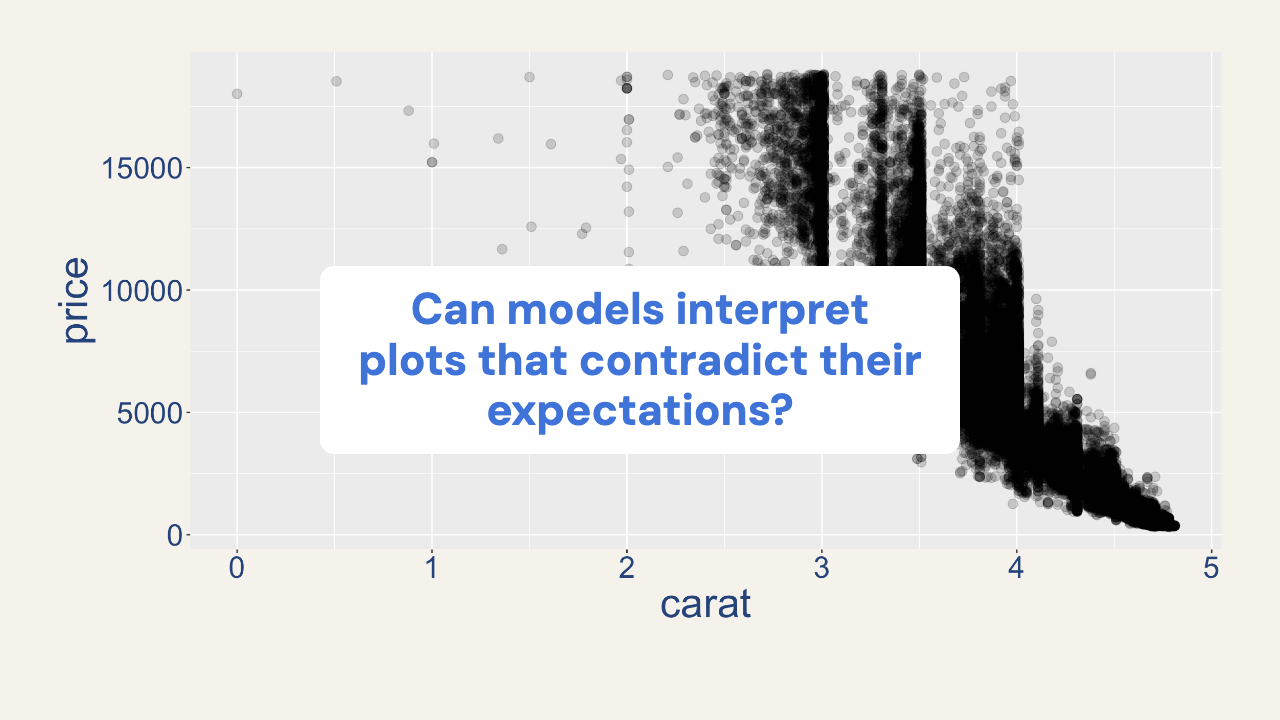
The models gave answers like, “There is a strong positive relationship between carat and price.” That sounds plausible until you look at the plot, which shows the opposite. Behind the scenes, we had manipulated the data to reverse a canonical relationship, so larger diamonds were, unintuitively, less expensive.
We wanted to know whether the models could see what was in front of them and interpret plots that contradicted their expectations. A year ago, the answer was largely no.
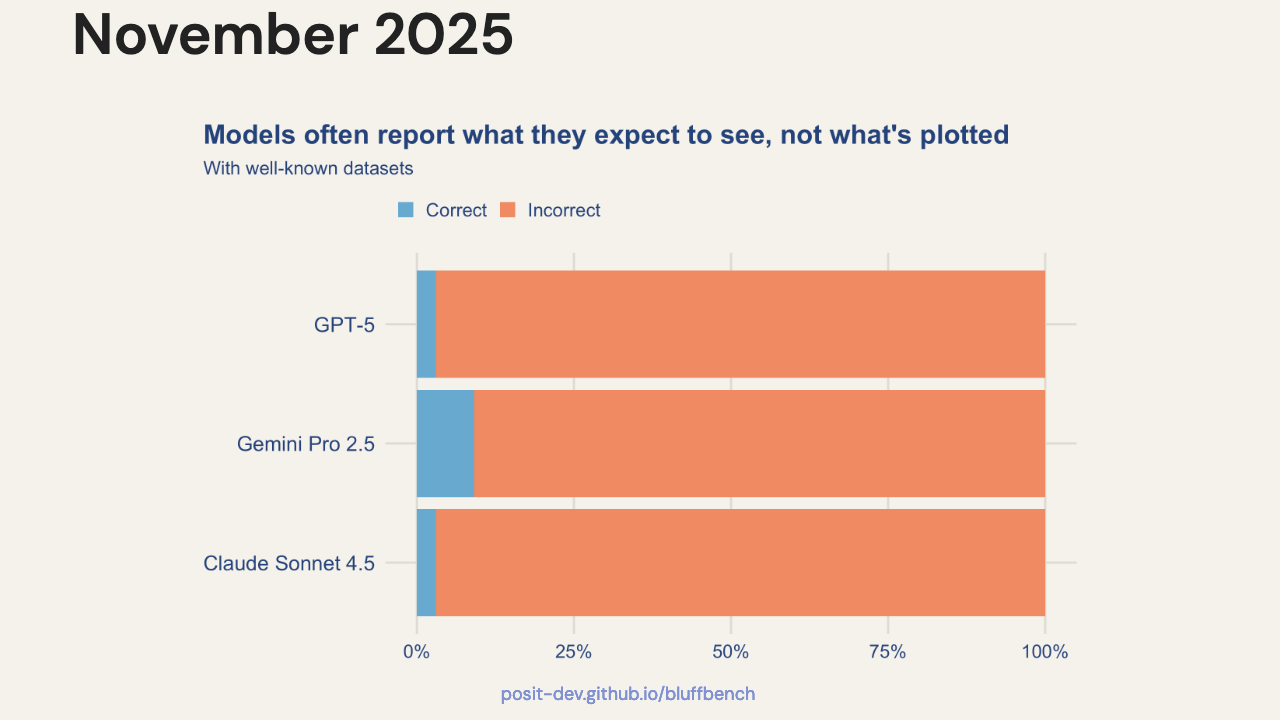
In November 2025, even the best models of the time were abysmal at this task. They said what they expected to see instead of paying attention to what was actually happening in the plot.
We tried all sorts of interventions to improve the bluffbench scores, and absolutely nothing worked. Then we waited six months.
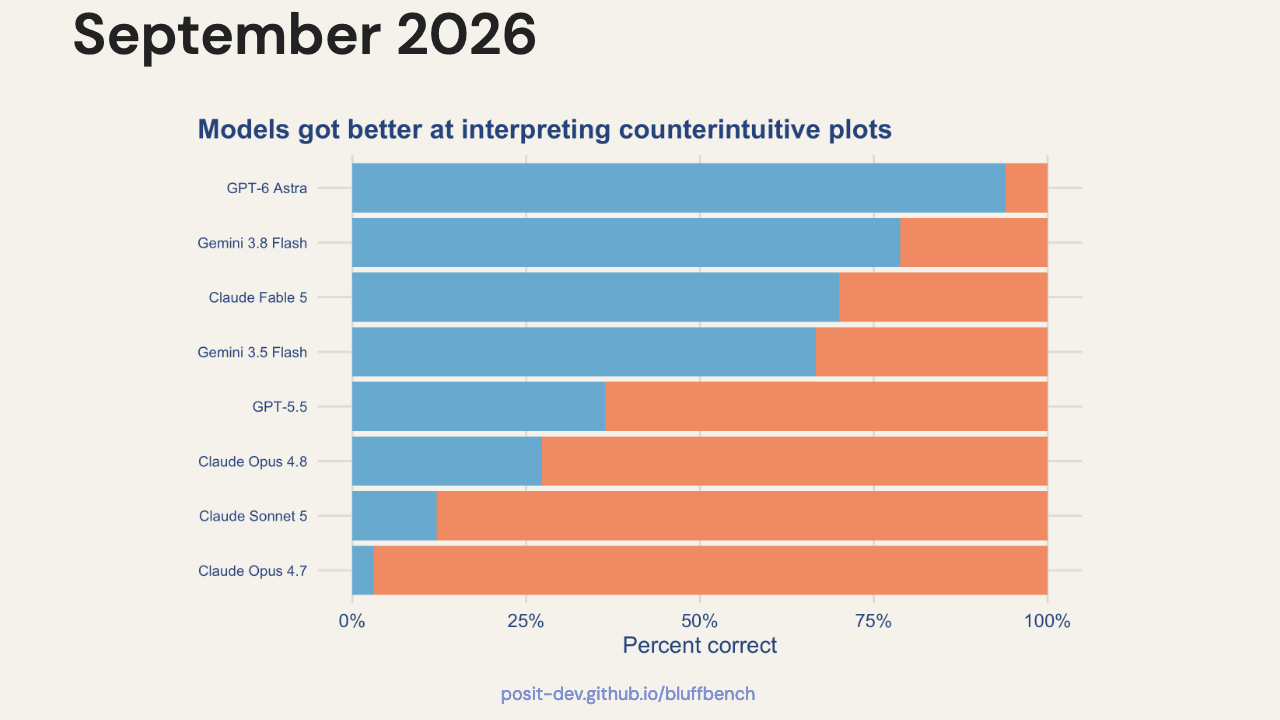
By May 2026, the major AI companies were releasing models that were noticeably better at the task. By September, the numbers had jumped dramatically: The models could interpret these counterintuitive plots.
The models got better. That does not mean data science is solved.
Models still make mistakes#
After that experiment, we asked another question: Can models identify data-quality issues in visualizations? In bluffbench2, we again showed them plots and asked what they saw.
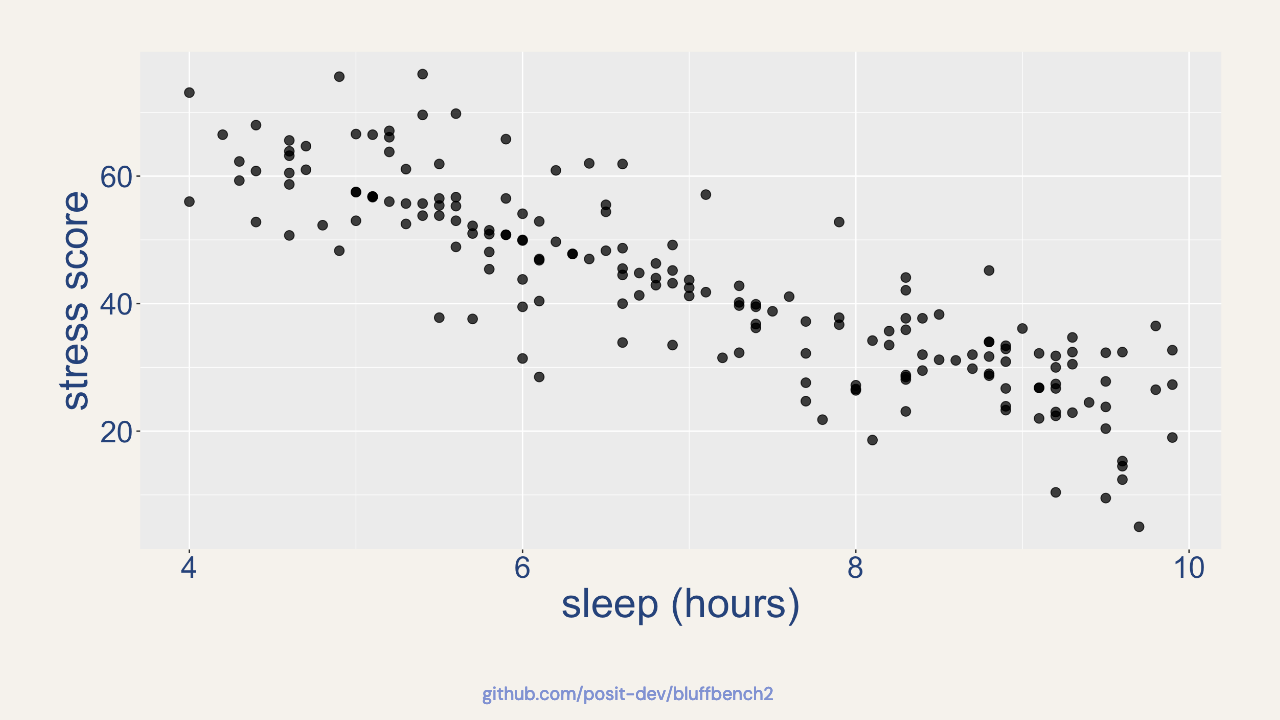
If you look carefully, there’s a suspiciously straight line through the cloud of points. If we really cared about this data, that’s something to investigate: Did something weird happen when the data was created? We wanted to know whether models would do the same.
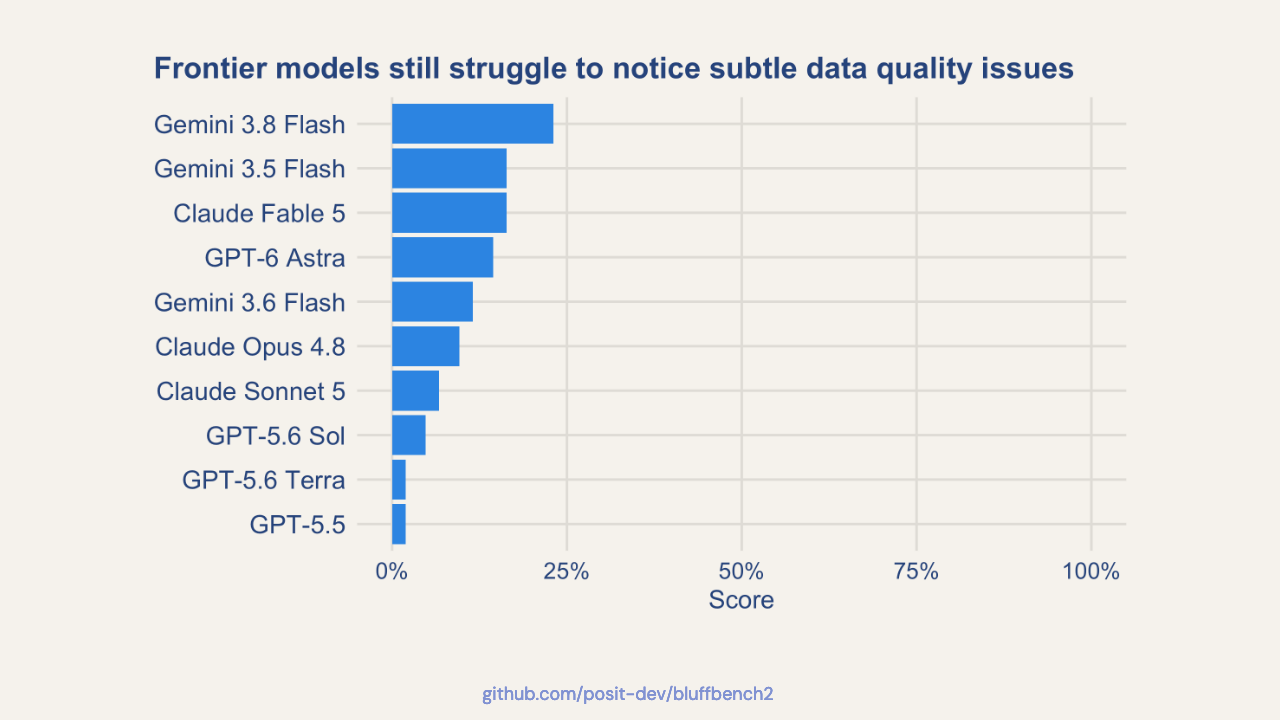
It turns out they don’t really. Even the leading models were not very good at this task. They struggle to notice subtle data-quality issues.
But there’s another problem. Data analysis is not just you, plus a good model, plus your data. It also depends on context that is not necessarily in your CSV file, warehouse table, or JSON file.
All data is constructed. It all has context. That context might live in a data dictionary, a Markdown file, or a semantic view. Maybe it just lives in the head of a coworker who has been at the organization for 15 years, knows absolutely everything, and has never written a single thing down.
That context is not inherently inaccessible to models. We could give it to them. But it has to be in the right format, it has to be curated, and it has to itself be correct.
So the models have gotten better, but data analysis with AI is not solved. The question then becomes: How do we make AI-involved analysis correct?
How do we make AI for data analysis trustworthy?#
(Sara)
Here’s a common thought about AI: It’s untrustworthy, but useful. To make it trustworthy, we need to add in a person.
Here’s a simple version of what that might look like. The agent or model does stuff, probably writes a bunch of code. A person then looks at that code and verifies, approves, or redirects as needed. That feeds back into the agent. This intuitively can feel really appealing. The agent gets to do what it’s good at, the person does what they’re good at, and there’s an expert there to keep everything from going off the rails.
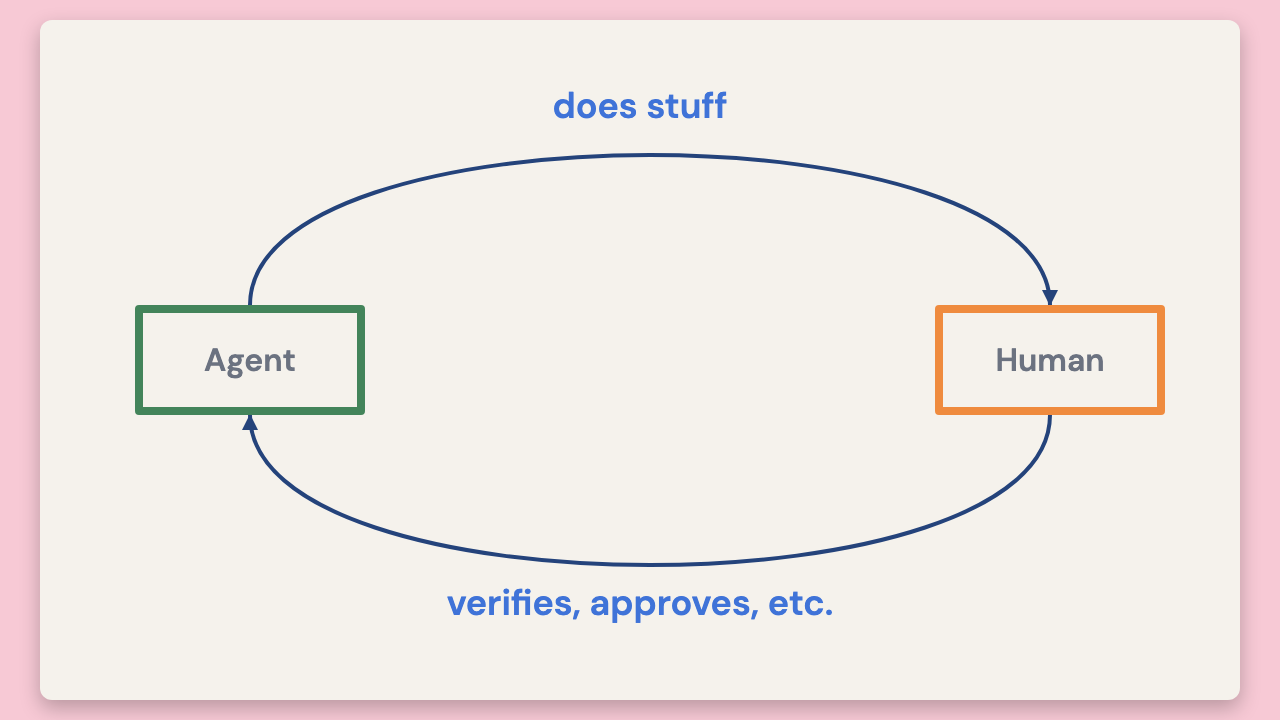
And so it’s kind of tempting to apply this pattern everywhere. Any time the agent might make a mistake, we have a person there to clean it up and make sure nothing bad happens. We call this relatively simplistic view the slap a human on it approach.
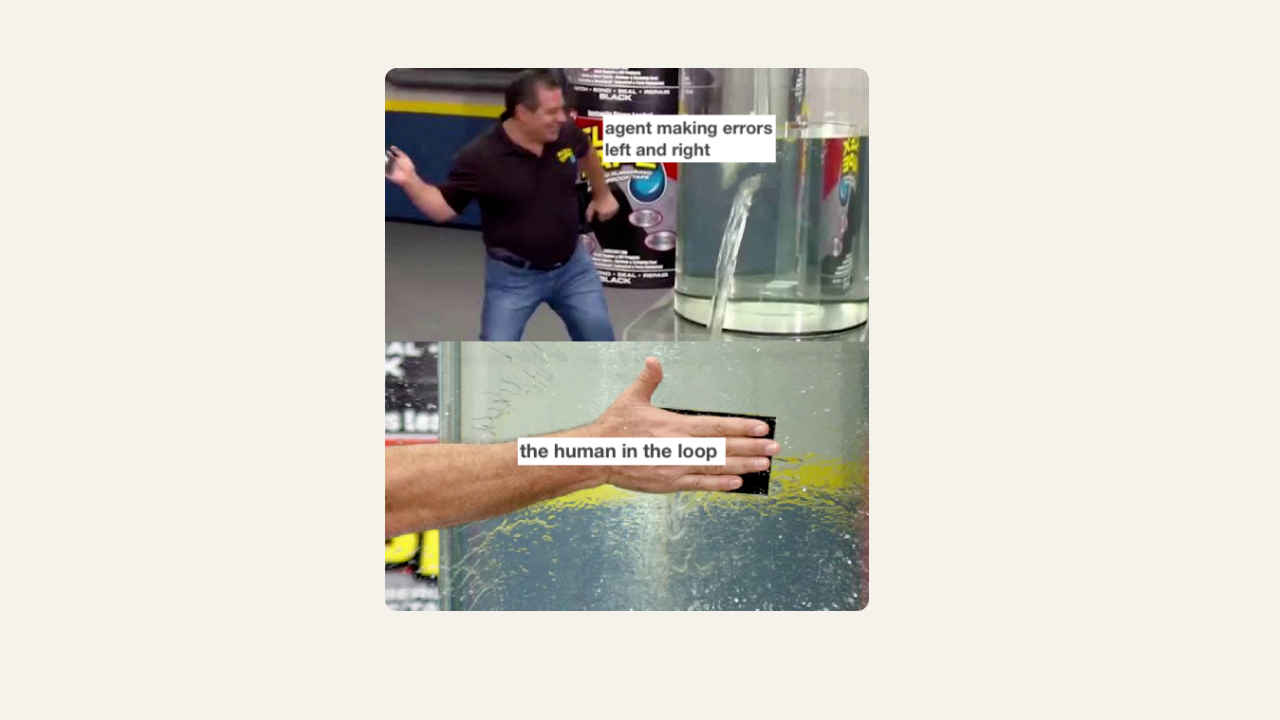
In this approach, you don’t really think very much about what the person will actually do. How will they apply their expertise? What is the purpose of their involvement? How will we keep them from technically being in the loop but without actually applying their expertise?
I’m being a bit facetious, but this isn’t that far from how we wrote risk mitigation with Databot a year earlier. We said that Databot and LLMs were not at a point where users could abdicate responsibility. You still needed all of your data skills to catch errors, interpret results in context, and avoid being misled by confident but incorrect claims.
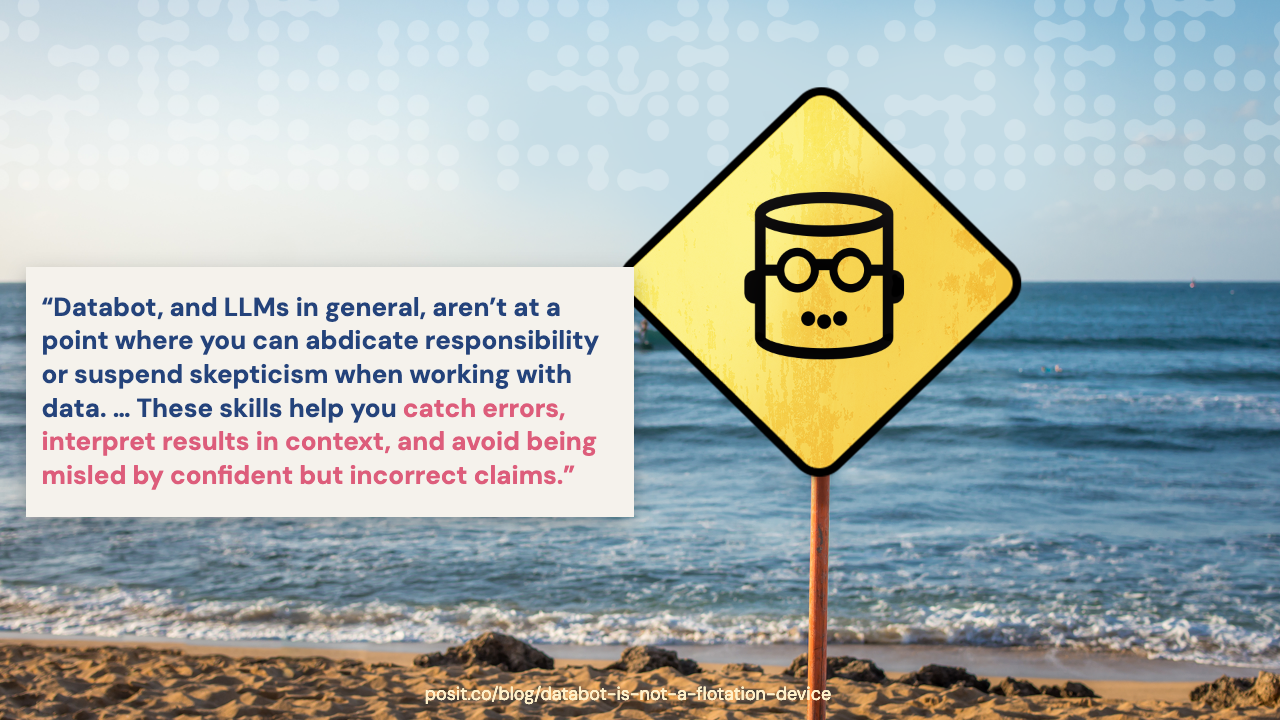
And all of that is still true! But we never said how this was supposed to happen. We assumed that if an expert was there, they would catch the mistakes.
But just adding a person doesn’t really guarantee a better result. Human–AI combinations do not reliably outperform the better of the human or AI working alone.
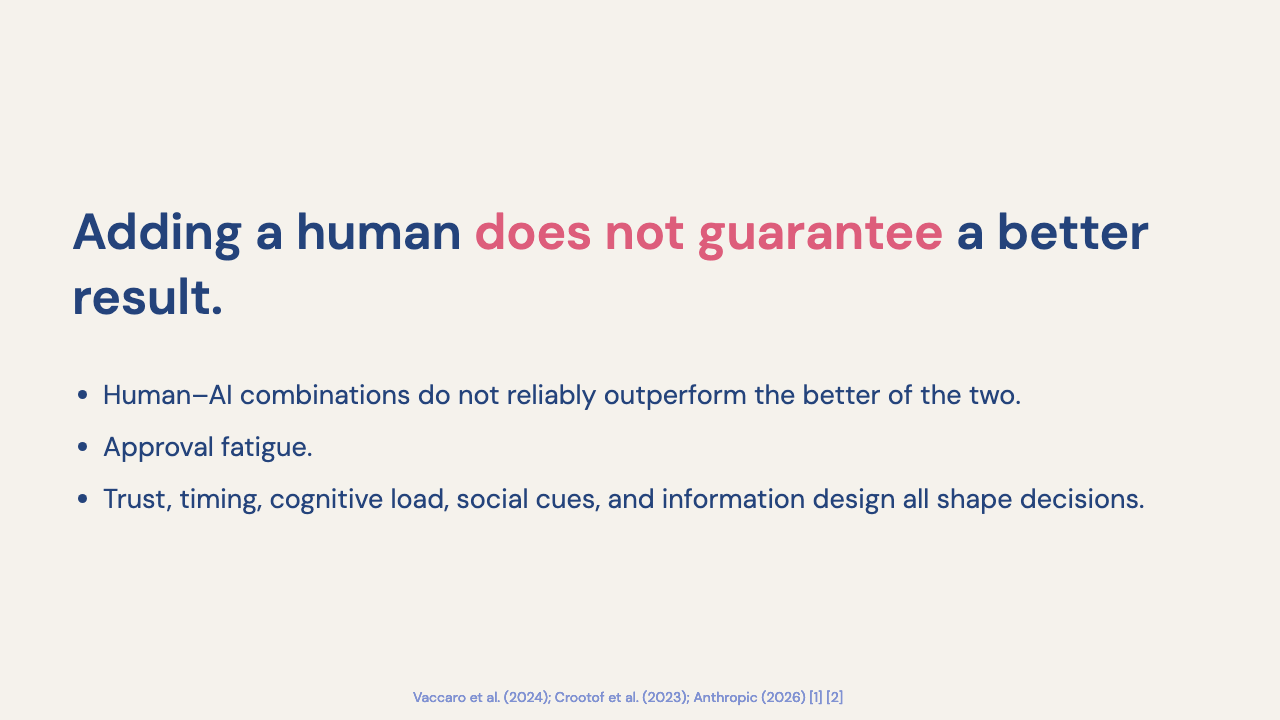
People also get tired of approving requests, and then they stop reading them. Think about the last time your coding agent showed you a command to approve. Did you carefully read it, or did you hit approve as quickly as possible and feel annoyed that it even bothered to ask?
Human decision-making is not fixed. How much you trust the system, how much you trust the people who built it, the timing of the information, your cognitive load, and how much your coworkers trust the agent can all influence the decision you make. Even if you are an expert who makes the right decision outside an interaction with an agent, adding the agent might change that decision.
So how do we design the entire system to produce correct work? How do we build trust and correctness into the agent itself, and design interactions with users that actually support their expertise?
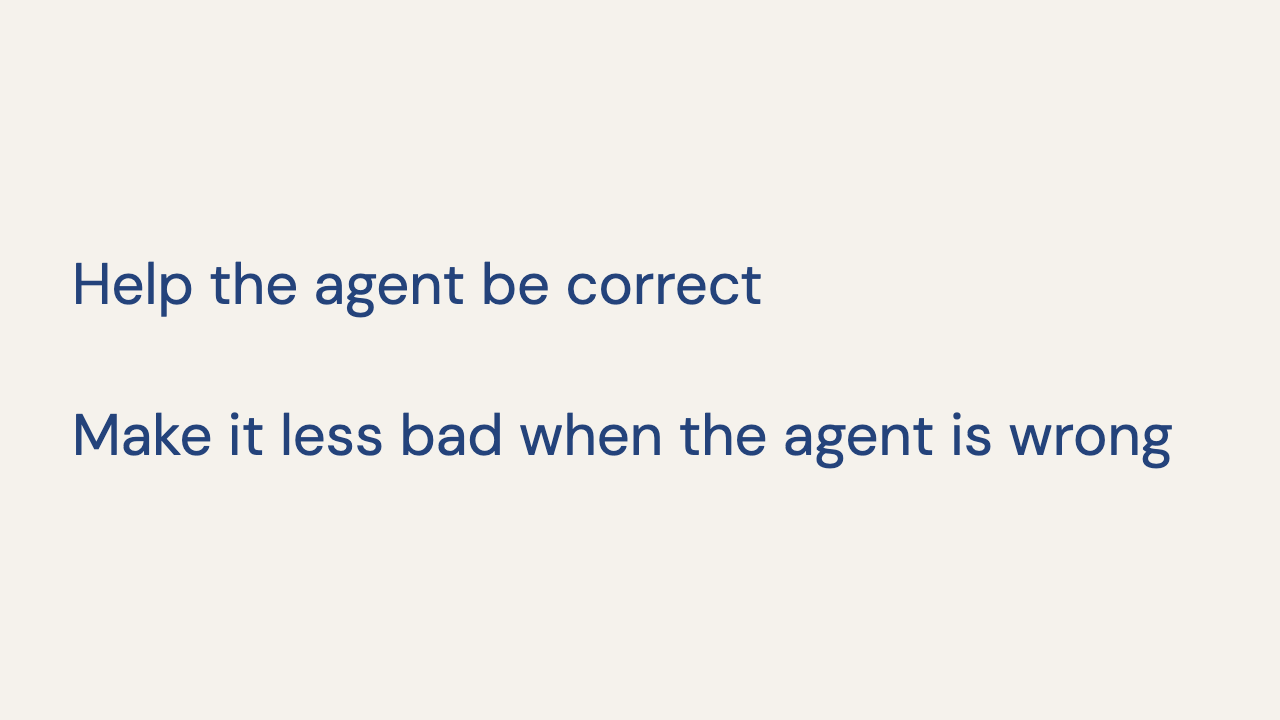
That maps onto two principles we returned to throughout the talk:
- Help the agent be correct.
- Make it less bad when the agent is wrong.
Posit Assistant#
(Simon)
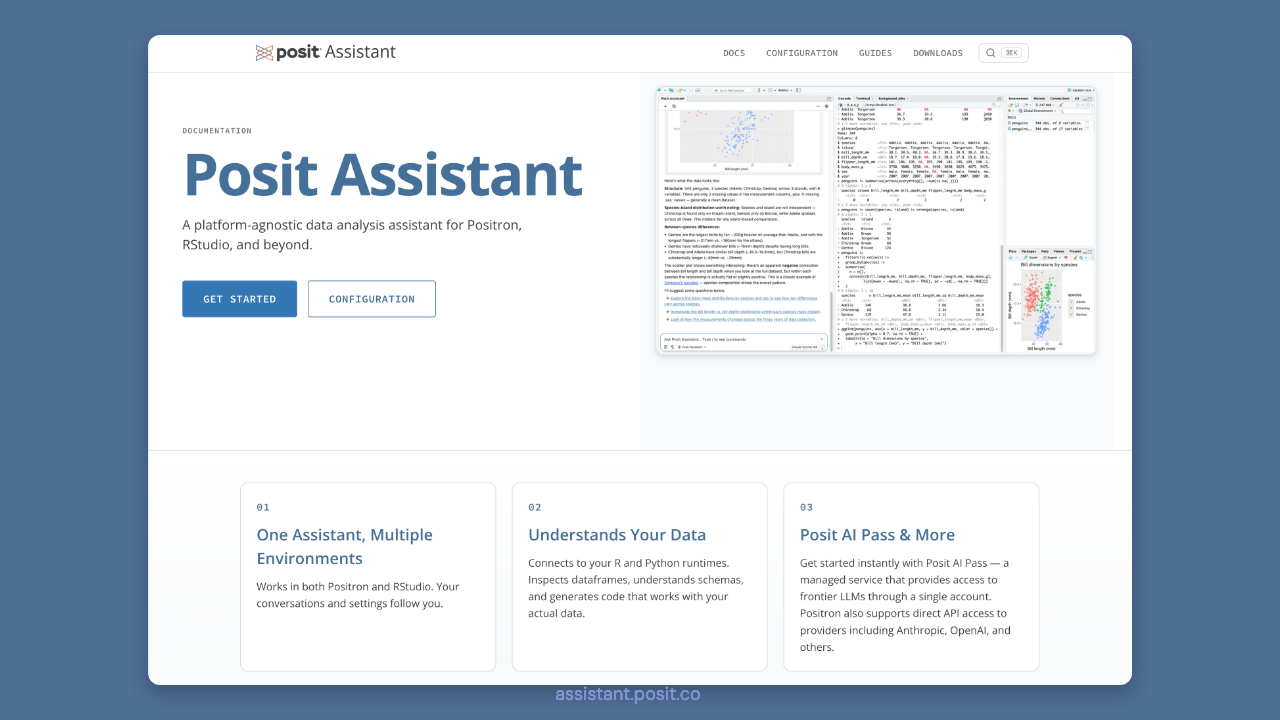
Posit Assistant is Posit’s coding and data science agent. It is available in RStudio, Positron, and the terminal. When it is running inside an IDE, it works in the same R or Python session you’re using. You can use whatever model you want from whatever provider you have access to.
For the demo, I returned to one of my first experiences of seeing below the surface with data science. In an introductory statistics class, I analyzed flight data to understand whether I could book tickets that were less likely to be delayed. I used ggplot2 and dplyr, pushing data frames around and visualizing them.
I asked Posit Assistant to find an R package with Houston flight data and
retrieve data from the previous year. It found anyflights, read its
documentation, and generated the correct call.
Next, I asked it to grab data from the same time the previous year. The agent read the package documentation and so was able to write the code with the right arguments the first time.
We have seen that many coding agents have a superficial relationship with data quality, and we wondered whether we could do better. Posit Assistant proactively recommends cleaning the data and has a dedicated data-cleaning mode. It runs scratch code to look for missing values, outliers, and similar issues. Once it finds them, it surfaces questions to the user in an interactive dialog.
In the demo, the agent found missing values in a relevant column, then found some flights with departure delays of multiple days. I chose to keep both: Those outliers represented what really happened.
At the end of cleaning mode, the agent wrote a persistent file in the project directory to ingest and clean the data. When someone revisits the analysis, they can reproduce those steps.
Posit Assistant also shows plots inside the conversation. It is nice to be able to see them, but we also think it is necessary: Our evaluations show that agents cannot reliably interpret plots. When one carrier appeared unusually delayed, it checked the sample size and found only 32 flights, suggesting that we should not read too much into the pattern.
Once the analysis was complete, I asked the agent to turn it into a persistent Quarto report.
I have one more “little zoomy zoom”: The entire conversation cost five cents.
Part of our mission at Posit is to provide tools to people regardless of their economic means.
Posit Assistant is designed to be token-efficient and can use capable, inexpensive open-weight models such as GLM 5.3 Flash through Posit AI Pass. We spend a lot of time watching the open-weights model space for models on the Pareto frontier: capable of data analysis and orders of magnitude cheaper than frontier models.
Returning to the two principles, part of helping the agent be correct is, quite literally, asking nicely. We say, “Pretty please pay attention to data cleanliness. Pretty please be open to uncertainty when carrying out data analysis.”
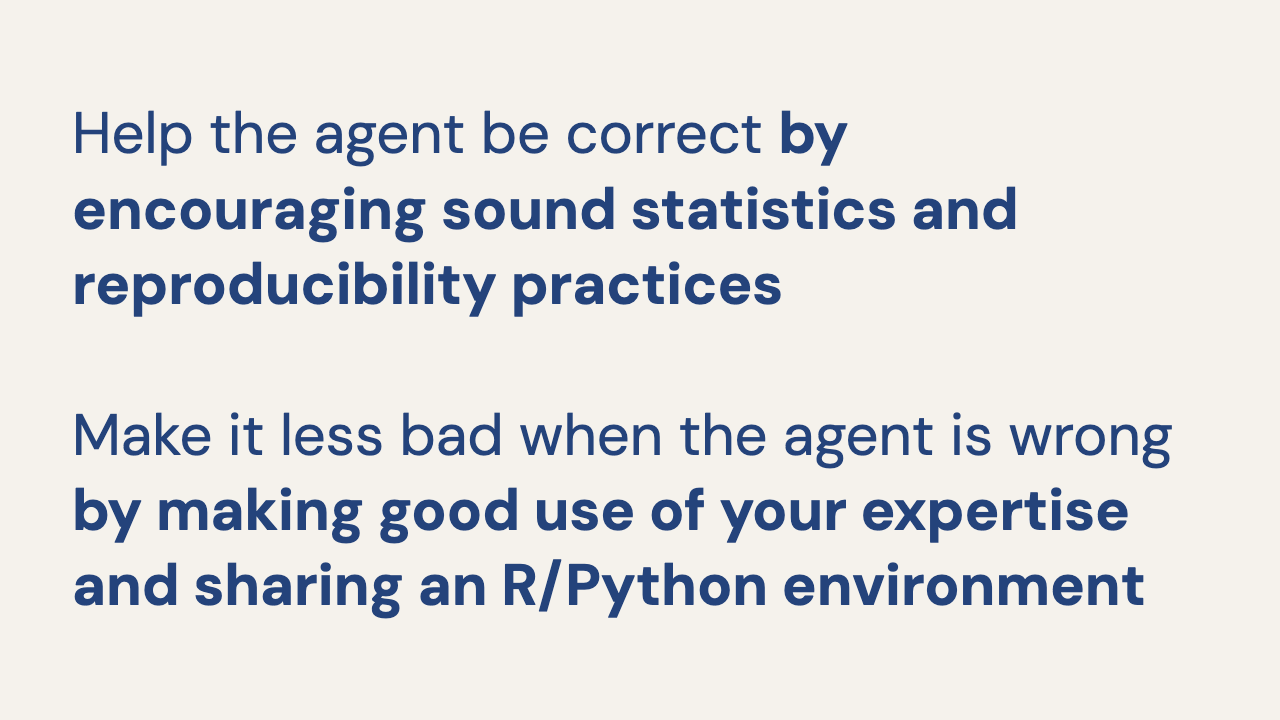
We also design interactions around the user’s expertise: Cleaning mode asks about the data-generating process, plots remain visible, and the user shares the agent’s R or Python session.
Posit Assistant assumes that the user is a data scientist, analyst, or someone else who writes code and wants to work in an IDE, close to that code. But what if the user is not a data scientist? How do we help them get correct answers, too?
Introducing commons#
(Sara)
Let’s return to our vibe-analyzing VP. I think it’s easy to say, “They just shouldn’t be doing this kind of analysis.” But let’s be on their side for a moment. They had a question, they wanted it answered, and so they’re going to reach for a tool that gives them an answer.
The problem is that they reached for the wrong tool and it gave them the wrong answer.
The data team already has vetted, maintained code that computes site traffic correctly. We call this trusted code. Trusted code might live in a package, Shiny app, Quarto document, report, or dashboard.
Instead of having the model write bespoke code from scratch every time someone asks a question, what if it could use that trusted code?
This is one of the core ideas behind a new open-source package that we’re excited to share with you all today. It’s called commons.
commons helps data scientists build trustworthy data agents for their collaborators. It is an open-source R and Python package built on the ellmer, chatlas, and shinychat stack.
(Simon)
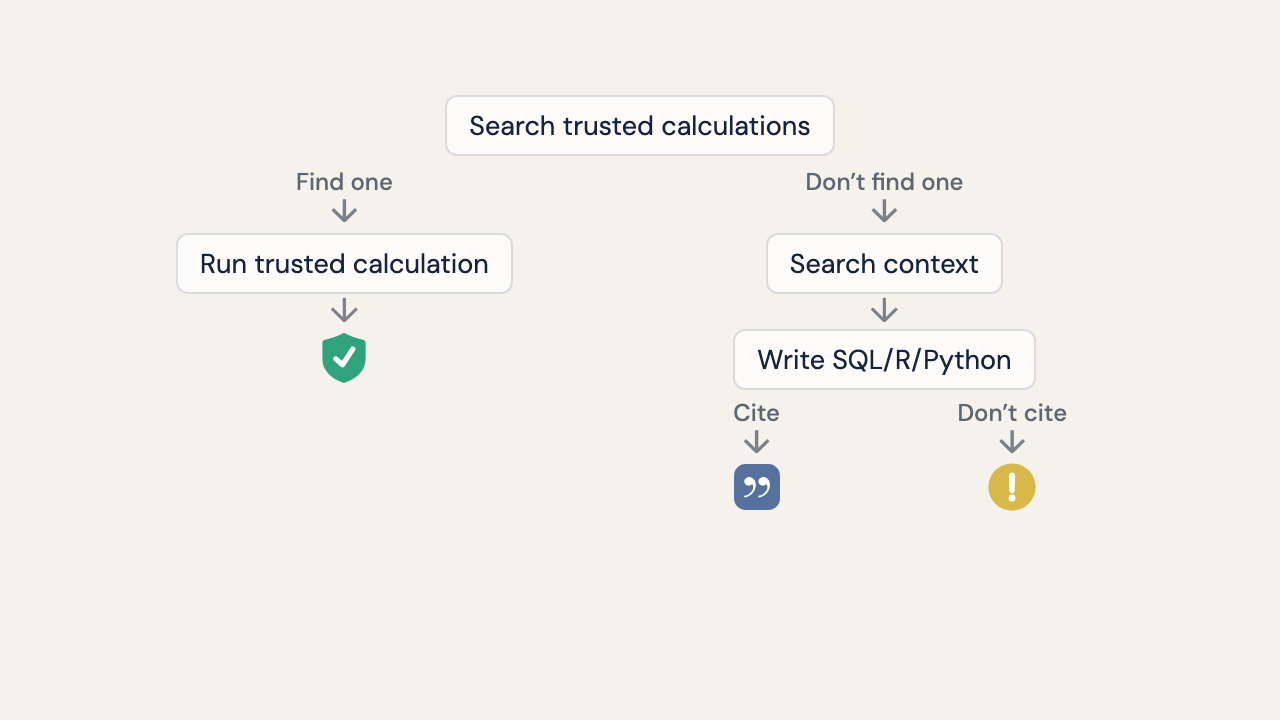
Here is how the VP’s analysis works with a commons agent. When the VP asks, “How is traffic trending for our site?” the first thing the agent does is search for a trusted calculation. If it finds one that answers the question, it invokes that calculation directly.
The calculation returns a plot and a green shield indicating that the answer came from a trusted calculation. commons adds that marker deterministically; the agent itself does not control it.
What makes coding agents so convenient is that they are everything tools. They will write their own R, Python, or SQL code to answer a question. Trusted calculations cannot cover every question, so commons has a fallback path.
When no trusted calculation exists, the agent can use context authored by the data team. commons verifies any citation against that context before displaying its blue citation marker.
If there is neither a trusted calculation nor supporting context to cite, the agent can write code, but commons displays a yellow warning so the user knows to treat the answer cautiously.
Here’s a diagram of the various ways the agent can come up with answers and how the trust relationships are mapped.
So far, we’ve been talking about the VP’s experience with the commons agent. What is it like to work with commons as a data scientist? There are three main loops: build, deploy, and improve.
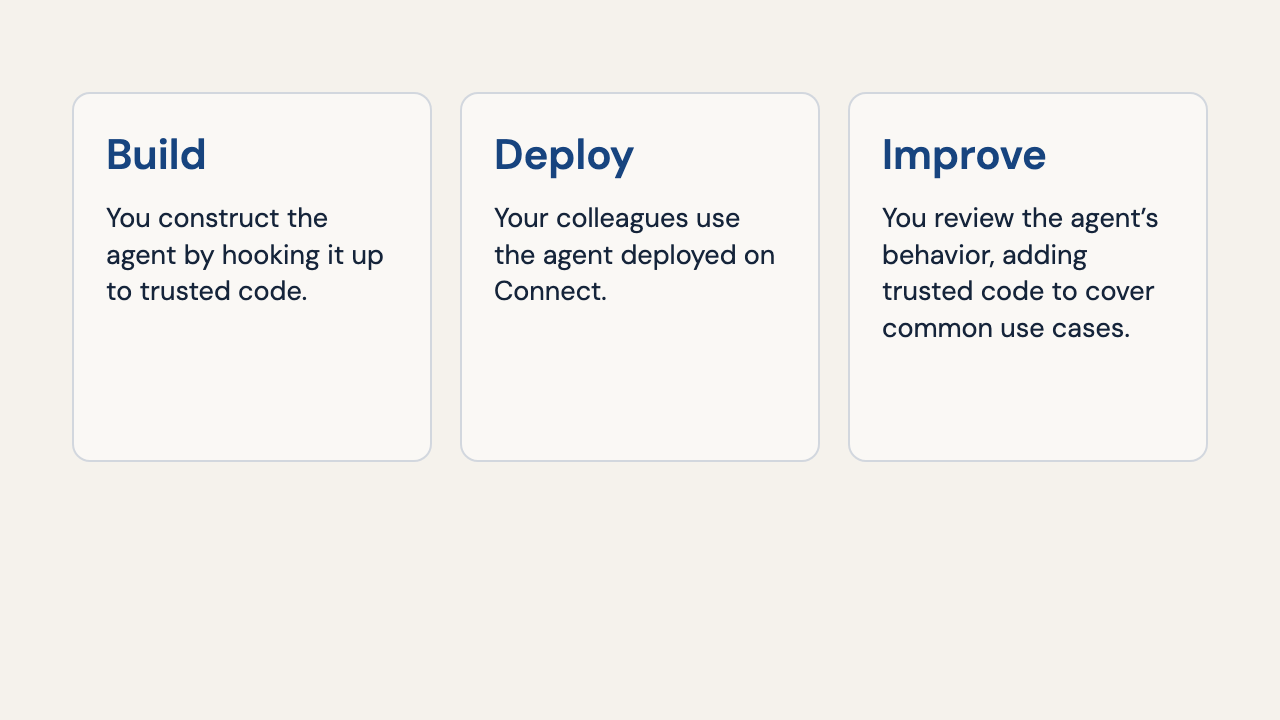
With data collection enabled, data scientists can review cases where the agent had to write its own code. If those cases share a pattern, they can add trusted code that moves future responses up the trust ladder, making the agent more correct over time.
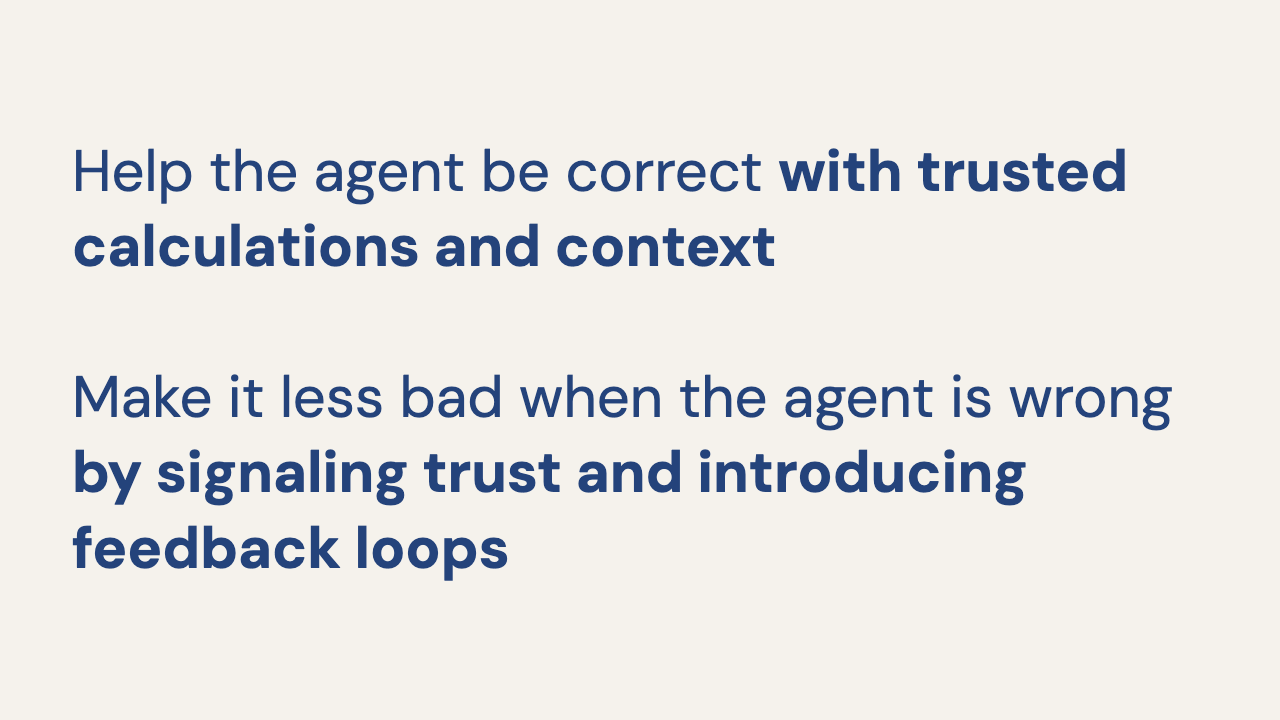
Returning to our two principles, commons helps the agent be correct by letting it directly use trusted code. It makes mistakes less bad by telling the user when the agent did not directly use trusted code, and by moving responses up the trust ladder over time.
Other use-cases for commons#
(Sara)
The VP example is business intelligence, but commons is not only for BI or vice presidents. It’s for any data person who wants to build an agent that gives correct answers to their collaborators.
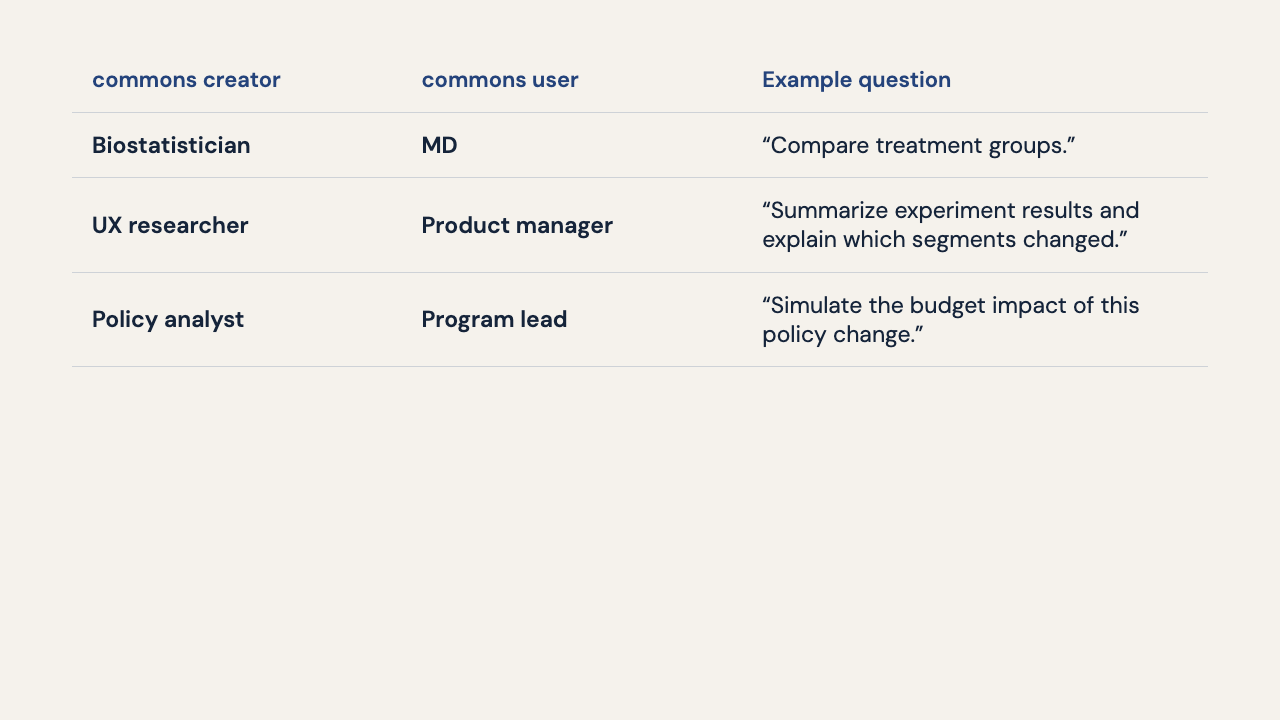
We’ve made a sample clinical trials agent to highlight this functionality. Its data is simulated. The trusted code is a TLG catalog: code written and trusted by data people to work on this type of data and produce correct answers. You can ask it questions such as, “Plot Kaplan–Meier curves.”
It is still very bad to be wrong#
(Sara)
It’s now so easy to ask any kind of agent a question about your data and get a wrong answer that looks completely plausible.
The problem is not just that the answer is wrong, and it’s also not just that you might be unable to reproduce it or have no idea how it arrived at the answer.
These are bad enough, but there’s another problem. If we become accustomed to, say, 15% of our numbers being wrong, we might lose trust in analysis itself and its ability to tell us things about the world, or become used to numbers just being a bit wrong all the time.
But correctness matters, especially in particular industries, and Posit has always built tools to support correct analysis. We do not think that standard should change just because AI is here.
But AI has expanded who can get answers from data. Now anyone can ask a question about their data. That changes how we need to think about the infrastructure for building correct, transparent, and reproducible agents.
With commons, a data team establishes which code and calculations it trusts and provides the organizational context the agent needs. The team can give that agent to someone who might otherwise perform a vibe analysis. That person keeps the convenience of asking questions in natural language, while the answers are grounded in the data team’s trusted work and can be traced and reproduced.
That is where data scientists and analysts come in. This infrastructure must be built by people who understand the data, calculations, and organization. commons helps them build it and make it available to others.
Looking forward#
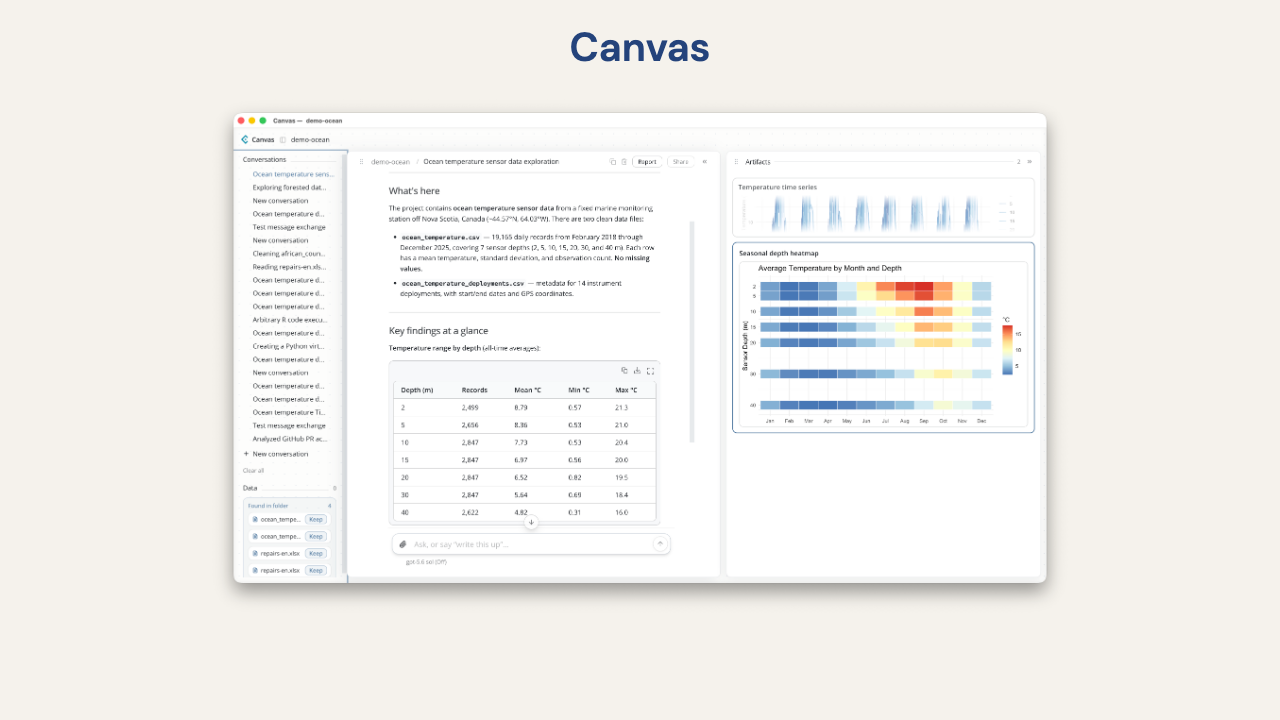
Looking forward, we have been experimenting with something called Canvas.
Canvas is a next-generation agent experience. It assumes that you might not always want to look at the code. That does not mean the code is not there when you need it, but you might not always want to work in an IDE.
This frees up real estate for expansive, new agent-collaboration interfaces. Canvas feels a little aggressively agentic to us, in the way Databot felt a year ago.